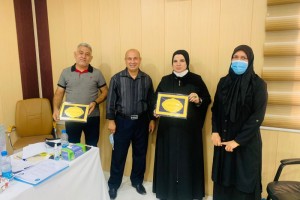
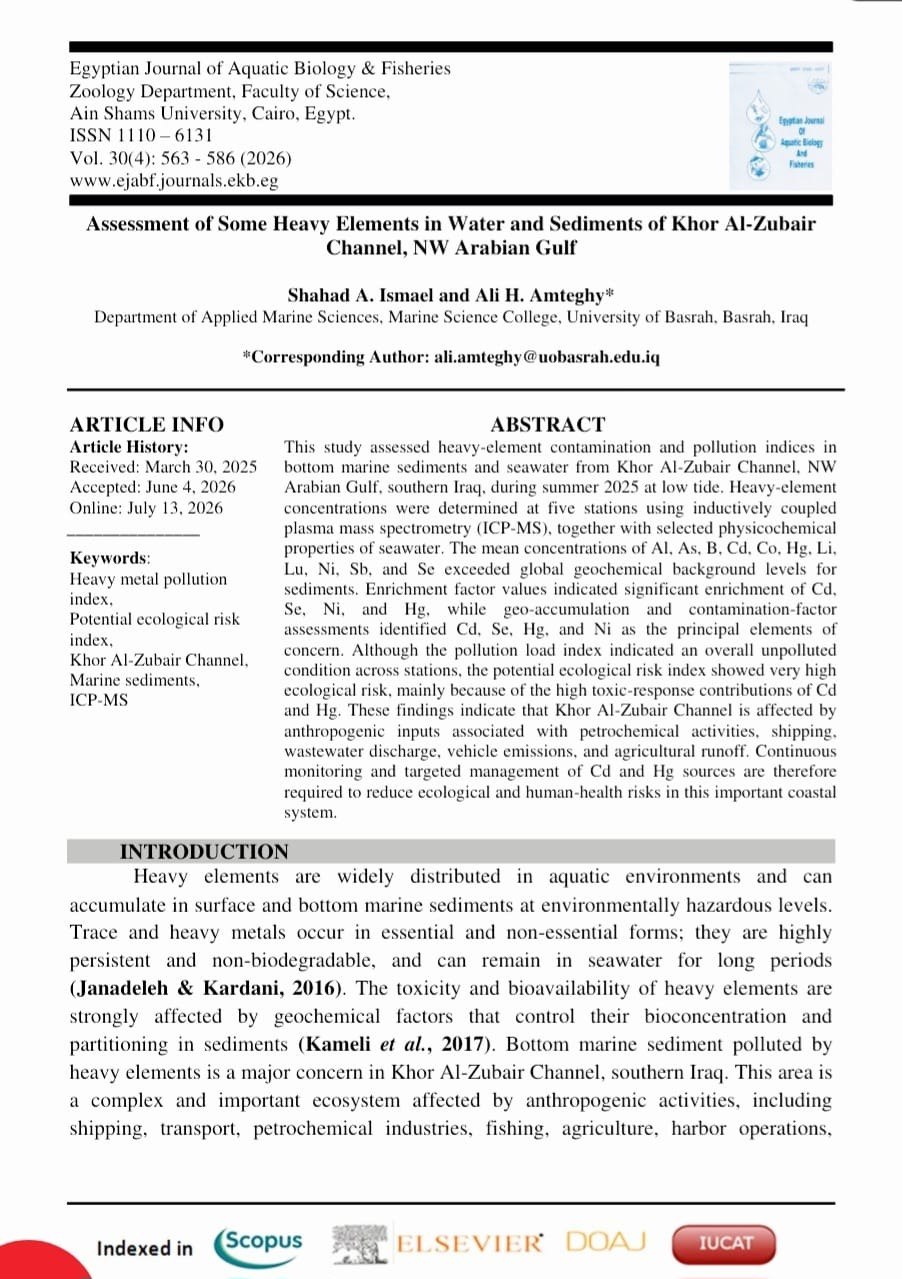
Professor Ali Hussein Amteighi and graduate student (Master's) Shahd Ahmed Ismail from the College of Marine Sciences at the University of Basra published a research paper titled “Evaluation of the Concentrations of Some Heavy Metals in Marine Sediments in the Khor Al-Zubair Channel, Northwest Arabian Gulf” in the Egyptian Journal of Aquatic Biology and Fisheries, Ain Shams University/Department of Zoology.
The study investigated the impact of pollution resulting from industrial and agricultural activities and untreated sewage discharged into the Khor Al-Zubair Channel. The channel extends as a shallow arm northwestward from the Arabian Gulf, bordered by the Shatt Al-Basra to the northwest and the Arabian Gulf to the southeast, thus necessitating an assessment of the environmental and health risks of pollution.
Marine sediment samples were collected during the summer of 2025 at the lowest tide level from five stations along the Khor Al-Zubair channel in southern Iraq. Induction-coupled plasma mass spectrometry (ICP-MS) was used to analyze the concentrations of heavy and radioactive elements, with the aim of determining pollution levels according to approved environmental pollution indicators, including the enrichment factor, enrichment factor, pollution factor, and geoaccumulation index of the studied heavy metals in the marine sediments.
Important News